
Why the Future of Connectivity Starts at the Component Level

As communications networks become more sophisticated, the performance of the smallest components matters more than ever.
When we talk about the future of connectivity, the conversation usually focuses on what networks will make possible: faster wireless service, more connected devices, smarter infrastructure, and new applications that depend on reliable, high-speed communications. But those advances depend on something less visible: the performance of the hardware that receives, processes, and transmits signals.
Every wireless connection depends on a chain of components and systems working together. And as networks become more demanding, the engineering decisions made at the component level can have consequences throughout that chain.
Why the smallest components matter
Consider the low-noise amplifier, or LNA. Its job is to amplify a weak incoming radio-frequency signal while introducing as little additional noise as possible.
That sounds straightforward, but it is one of the fundamental challenges of wireless engineering. When a receiver adds too much noise, it becomes harder to distinguish the intended signal from interference and other unwanted energy. The result can be reduced sensitivity and less reliable communications.
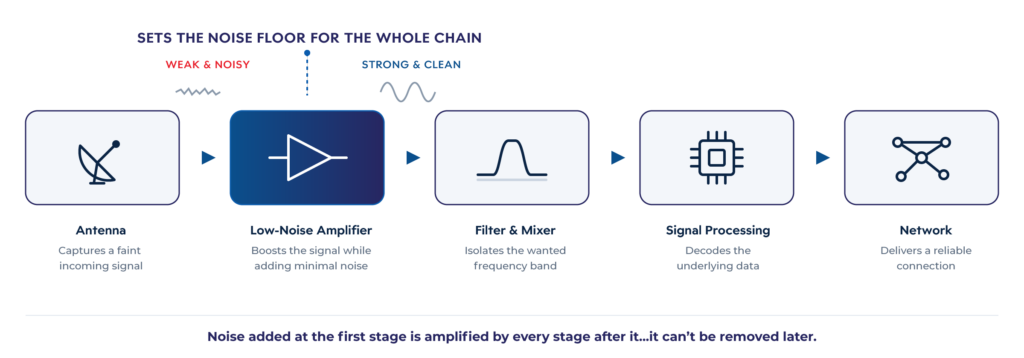
In a satellite ground station, where signals may have traveled thousands of miles before reaching an antenna, low-noise performance is particularly important. The same underlying engineering principles matter in cellular radio systems, where receiver performance contributes to the overall quality and reliability of a wireless connection.
The lesson is that network performance doesn’t begin at the tower or the satellite. It begins with the components inside the equipment.
Connecting RF component design to system performance
Traditionally, companies developing communications equipment may source critical components from multiple suppliers and integrate them into a finished system. That approach has advantages, but it can also introduce design constraints. Engineers must work within the performance characteristics of the components available to them.
An integrated engineering approach creates another possibility: designing critical components with the requirements of the finished system in mind.
At AmpliTech Group, this relationship is central to how we develop technology. Our microwave design center develops proprietary monolithic microwave integrated circuits (MMICs), including low-noise amplifier designs, while our RF and microwave engineering teams bring decades of experience developing components and subsystems for demanding applications.
That expertise also informs our 5G radio development, where component-level design and system-level engineering come together.
The objective isn’t integration for its own sake. It’s the ability to make engineering decisions across different levels of a system, with a clearer understanding of how those decisions affect overall performance.
“Network performance doesn’t begin at the tower or the satellite. It begins with the components inside the equipment.”
Different applications, shared engineering challenges
Satellite communications and terrestrial 5G networks may seem like very different businesses. One depends on receiving signals from orbit; the other connects mobile devices through networks of terrestrial radio equipment.
Yet both face fundamental RF engineering challenges involving signal strength, noise, efficiency, and reliability. In satellite communications, receiver sensitivity is critical to recovering weak signals. In 5G networks, radio performance must be considered alongside interoperability, deployment requirements, and the demands of operating in complex real-world environments.
The specific equipment, standards, and operating conditions differ. But the importance of sound component-level engineering remains constant.
This is one reason AmpliTech’s capabilities extend across RF components, microwave design, satellite communications, and 5G infrastructure. The technologies serve different markets, but they draw on a common foundation of signal engineering expertise.
Engineering for what comes next
The demand for connectivity will continue to evolve. Mobile networks are becoming more flexible, enterprises are exploring dedicated wireless infrastructure, and satellite communications are playing an increasingly important role in connecting remote and underserved locations.
Meeting those needs will require advances throughout the communications ecosystem, from semiconductor design and RF components to complete systems and network integration.
There is no single component or technology that determines how well a network performs. Spectrum, software, architecture, deployment conditions, and many other factors all matter. But the quality of the underlying signal remains fundamental.
As the industry develops new ways to connect people, businesses, and infrastructure, the engineering that makes those connections possible will be just as important as the applications they enable.